
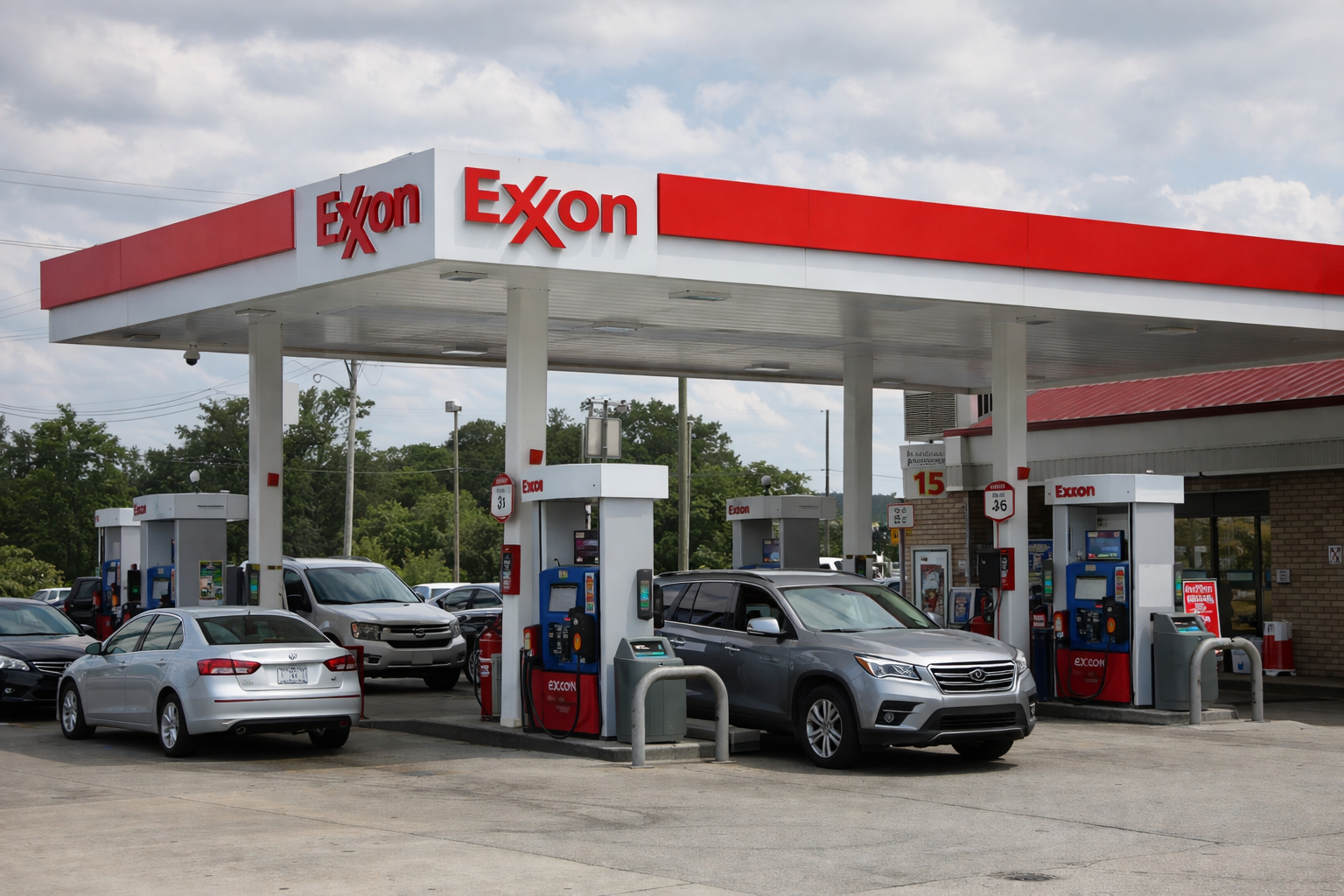
Exxon Mobil reported a mixed performance for the first quarter of 2026. While the company’s revenue exceeded expectations, its adjusted earnings per share were below forecasts.
This shortfall was primarily attributed to substantial one-off charges and timing issues related to derivatives.
The stock fell 1.6% on Friday after the results came out.
The strong underlying operational performance wasn’t enough to save investor sentiment on Friday.
Exxon surpassed expectations on both earnings and revenue. The company reported adjusted earnings of $1.16 per share, exceeding the $1.00 per share estimate.
Furthermore, Exxon’s revenue of $85.14 billion was higher than the $82.18 billion projected by analysts.
Timing effects and conflict costs
The company reported quarterly earnings of $4.2 billion, which translates to $1.00 per share.
Excluding identified items, earnings were higher at $4.9 billion, or $1.16 per share.
When also excluding unfavorable estimated timing effects, earnings reached $8.8 billion, equivalent to $2.09 per share.
The $3.9 billion impact on timing primarily resulted from the discrepancy between the valuation of financial derivatives and their corresponding physical transactions.
Exxon’s trading division implemented financial hedges to secure the profit from the barrels.
However, the value of these shipments was not included in the quarterly results because the barrels were still in transit to their final destinations.
The company experienced an approximate $4 billion loss in the quarter, which the company attributed to a “timing effect” because the hedges were not yet balanced by the proceeds from product deliveries.
Exxon noted that this impact is temporary, and the hedges are expected to yield a net profit in future quarters once the products have been delivered.
Additionally, identified items totaling $0.7 billion were incurred as losses on settled financial hedges that were not counterbalanced by physical shipments.
This lack of offset was due to supply disruptions in the Middle East, which were caused by the conflict between the US and Iran.
Operational strength, conflict impact and shareholder return
Shareholder distributions totaled $9.2 billion, comprising $4.3 billion in dividends and $4.9 billion in share repurchases. This was funded by the $8.7 billion in cash flow generated from operating activities.
“This quarter demonstrated that ExxonMobil is a fundamentally stronger company than it was just a few years ago, built to perform through disruption and across market cycles,” Darren Woods, chairman and chief executive officer, said in a statement.
Events in the Middle East tested that strength with the safety of our people remaining our top priority. Those events also underscored the importance of reliable, affordable energy products and the value of the capabilities we have built to deliver them
Darren Woods
CEO and chairman, ExxonMobil
Upstream earnings for Exxon, excluding one-time items and timing effects, totaled $6.3 billion.
This was primarily driven by strong volume growth in strategic areas, notably Guyana and the Permian Basin.
The company achieved a net production of 4.6 million oil-equivalent barrels per day.
Production in Guyana reached a new quarterly high, exceeding 900,000 gross barrels of oil per day.
Additionally, Golden Pass LNG’s Train 1 began production in March, contributing to a 5% increase in US LNG exports.
The company’s cash capital expenditures amounted to $6.2 billion, aligning with its previously issued full-year guidance range of $27 billion to $29 billion.
Additionally, a second-quarter dividend of $1.03 per share was declared, scheduled for payment on June 10, 2026.
Additionally, Exxon’s Woods informed CNBC that roughly 15% of the company’s production is currently affected by the ongoing conflict.
Woods stated that once the strait is reopened, it will take as long as two months for oil flows to reach full capacity.
Furthermore, he noted that it takes approximately one month for oil barrels shipped from the Persian Gulf to arrive at their destinations.
According to Woods, Exxon rerouted approximately 13 million barrels to the markets most in need during the conflict.
However, the CEO noted that this redeployment had a detrimental effect on Exxon’s first-quarter earnings from an accounting perspective.
The post ExxonMobil earnings mixed as conflict costs weigh; shares slips appeared first on Invezz
