
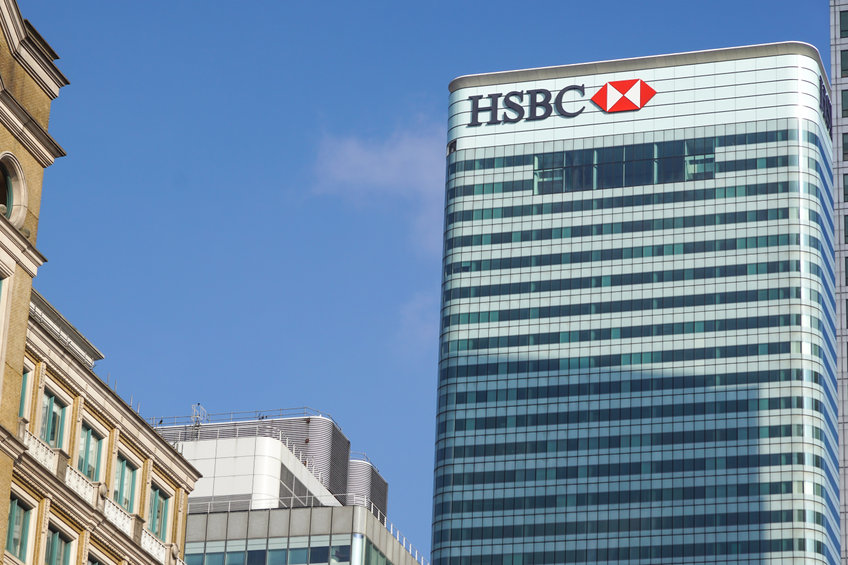
HSBC delivered a broadly flat first-quarter profit that fell short of analyst expectations, as a specific fraud-related credit charge in its UK institutional banking unit and rising provisions linked to the US-Iran conflict pushed credit losses sharply higher.
The result underscores how geopolitical turbulence and isolated credit events can rapidly erode what might otherwise be a stable earnings picture, even as the bank’s wealth and interest income businesses continued to grow.
HSBC stock rose after posting the Q1 earnings and was trading 0.5% up from its previous close.
HSBC Q1 earnings: The headline numbers
HSBC reported pretax profit of $9.4 billon for the January-to-March quarter, a $0.1 billon decline from $9.5 billon in the same period a year earlier, and below the $9.59 billon average estimate compiled from broker forecasts.
The bank approved a first interim dividend for 2026 of $0.10 per share, payable on 26 June to shareholders on record as of 15 May.
Revenue growth from strong Wealth fee income and higher banking net interest income provided partial support, but was insufficient to offset the combined drag from elevated credit charges, rising operating costs and an adverse swing in notable items.
What drove the shortfall
The primary culprit was a surge in expected credit losses (ECL).
ECL totalled $1.3 billon in the first quarter, $0.4 billon higher than in Q1 2025.
The charge was driven by two main components: a $0.4 billion fraud-related exposure tied to a secondary securitisation with a financial sponsor in the UK, booked through the Corporate and Institutional Banking (CIB) division.
It also included a $0.3 billion increase in allowances reflecting heightened uncertainty and a deterioration in the forward economic outlook following the onset of the Middle East conflict on 28 February 2026.
The fraud-related charge is distinct from ordinary credit deterioration — it reflects a specific structured finance exposure that went wrong, rather than a broad worsening of loan quality across the UK corporate book.
That distinction matters for investors assessing whether the provisioning trend is systemic or idiosyncratic.
Operating expenses also climbed, rising $0.6 billon, or 8%, to $8.7 billon compared with Q1 2025, driven by the phasing of performance-related pay, inflation, higher planned technology investment and an adverse foreign currency translation effect of $0.4 billon.
Revised guidance and capital position
Despite the miss, HSBC upgraded its revenue outlook for the year.
The bank now expects banking net interest income of around $46 billon in 2026, up from its previous guidance of at least $45 billon, citing an improved interest rate environment, while acknowledging that the outlook remains volatile.
It also revised its ECL charge guidance upward to approximately 45 basis points of average gross loans, from a prior estimate of around 40 basis points, reflecting continued uncertainty.
HSBC confirmed it remains on track to deliver $1.5 billon in annualised cost reductions by the end of June 2026 through its organisational simplification programme, and retained its return on tangible equity target of 17% or better for 2026, 2027 and 2028, excluding notable items.
Its common equity tier 1 capital ratio stood at 14.0% at the end of March, down 0.9 percentage points from the fourth quarter, partly reflecting the privatisation of Hang Seng Bank, dividends paid and an increase in risk-weighted assets.
Why it matters
For a bank of HSBC’s scale — one of the world’s largest by assets, with a loan book weighted heavily towards Asia — the Q1 result carries considerable diagnostic value.
The combination of a fraud-related charge and Middle East war provisions illustrates the twin risks that multinational lenders face: idiosyncratic credit events that are difficult to predict and geopolitical shocks that rapidly reshape the macro environment in which they operate.
Chief executive Georges Elhedery said HSBC was navigating greater uncertainty “from a position of strength,” adding that customers were increasingly turning to the bank as a trusted partner to help them manage complexity.
With its four-division restructuring — separating Hong Kong, UK, CIB and International Wealth and Premier Banking — now bedded in, management’s ability to absorb elevated ECL while maintaining its RoTE target will be the key test for investors in the quarters ahead.
The post HSBC stock rises on Q1 earnings: can it hold gains despite profit miss? appeared first on Invezz
