
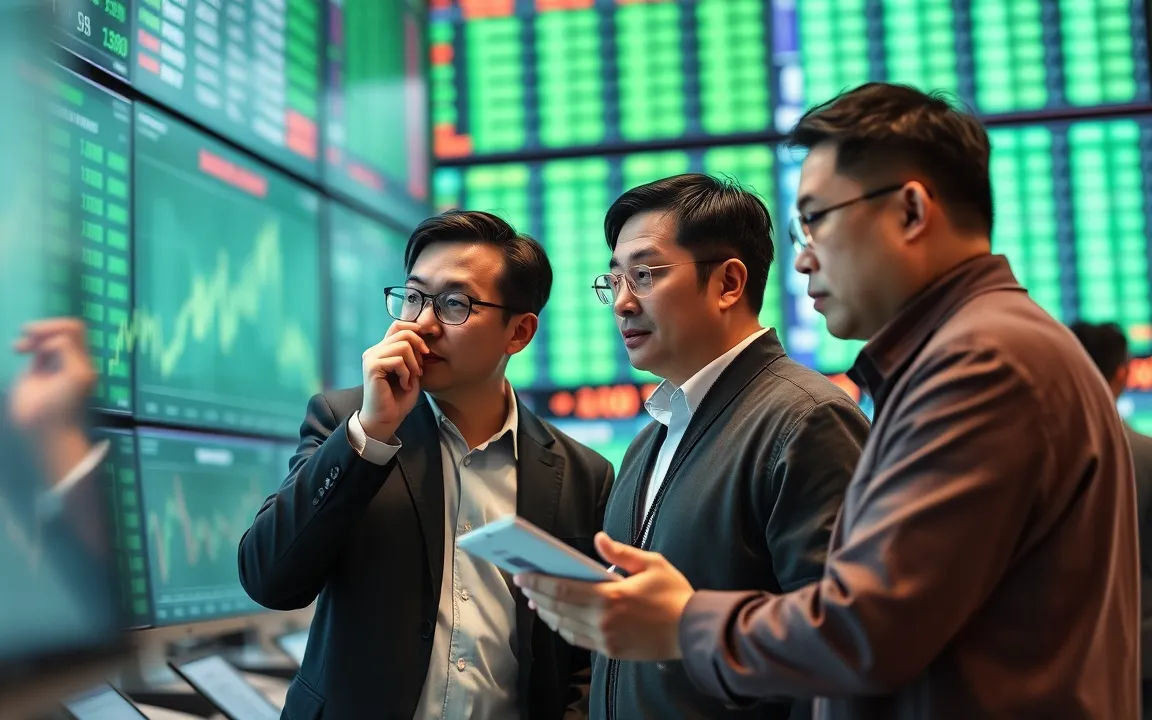
Asian stocks surged on Friday as strong results from Microsoft and Amazon revived confidence in artificial-intelligence spending, helping South Korea’s battered market stage a record comeback.
The Kospi jumped as much as 16.5%, while Japan’s Nikkei climbed more than 5% and Taiwan’s Taiex gained over 7%.
The advance followed a powerful Wall Street rally led by technology shares, although the Kospi was still heading for its worst month since 1997 after a violent sell-off earlier in the week.
Microsoft and Amazon reset the AI debate
The rebound was driven by evidence that heavy investment in data centres and chips is translating into faster cloud growth.
Microsoft reported quarterly revenue of $90 billion, up 18%, while Azure sales rose 43%. Microsoft Cloud revenue increased 27% to $59.3 billion.
Amazon provided a second boost. AWS revenue grew 37% to $42.2 billion, its fastest pace in 18 quarters, while group sales rose 20% to $200.6 billion.
The company also lifted its 2026 capital-spending plan to about $220 billion, signalling that demand remains strong enough to justify another increase in infrastructure investment.
IG market analyst Fabien Yip said the earlier sell-off had become exaggerated because the underlying AI demand story had not materially weakened.
Deutsche Bank strategists viewed the correction as a reset in expectations after an exceptional rally rather than a breakdown in the investment case.
Investors are no longer rewarding AI spending by default.
Microsoft’s cash generation and Amazon’s accelerating cloud growth showed that some of the largest programmes are producing measurable returns.
Korea’s comeback does not erase the damage
Samsung Electronics and SK Hynix led the reversal after suffering historic losses earlier in the week.
Their rebound helped lift the Kospi, but the index remained nearly 25% lower for July and well below its June peak.
That leaves Friday’s move looking more like a violent repricing than a clean return to stability.
South Korean authorities have already tightened oversight of leveraged single-stock products after the sell-off amplified losses for retail investors.
The rally may therefore need more than strong US earnings to last. Investors will watch margin balances, foreign flows and whether chipmakers can sustain pricing as Chinese competitors expand.
The sector still faces the question that triggered the rout: whether capital expenditure can keep rising without weakening free cash flow or returns on invested capital.
The yen and bond market keep risks alive
The yen weakened about 0.8% to 160.76 per dollar after the Bank of Japan kept its policy rate at 1% in an 8-1 decision.
Board member Hajime Takata favoured a quarter-point increase, but the central bank offered limited guidance on the timing of another move.
The decision followed suspected coordinated currency intervention that had driven the yen sharply higher on Thursday.
SMBC analysts said the hold was expected, although Takata’s dissent increased the possibility of an October increase.
Capital Economics argued that intervention alone may struggle to deliver a lasting yen recovery without firmer monetary support.
Bond markets provide another warning.
Long-dated US Treasury yields remained near 19-year highs even as short-term yields eased, reflecting concern that inflation expectations are becoming harder to anchor.
Oil fell despite fresh threats to Middle East shipping, with Brent near $88 a barrel.
The restrained reaction prevented another inflation shock, but it also underscored how quickly geopolitical risk could return.
Friday’s rally repaired confidence in the AI trade. It did not remove the currency, rates and geopolitical risks that made Asia’s sell-off so severe.
The post Kospi, Nikkei 225 soar: is Asia’s AI rebound strong enough to last this time? appeared first on Invezz
