
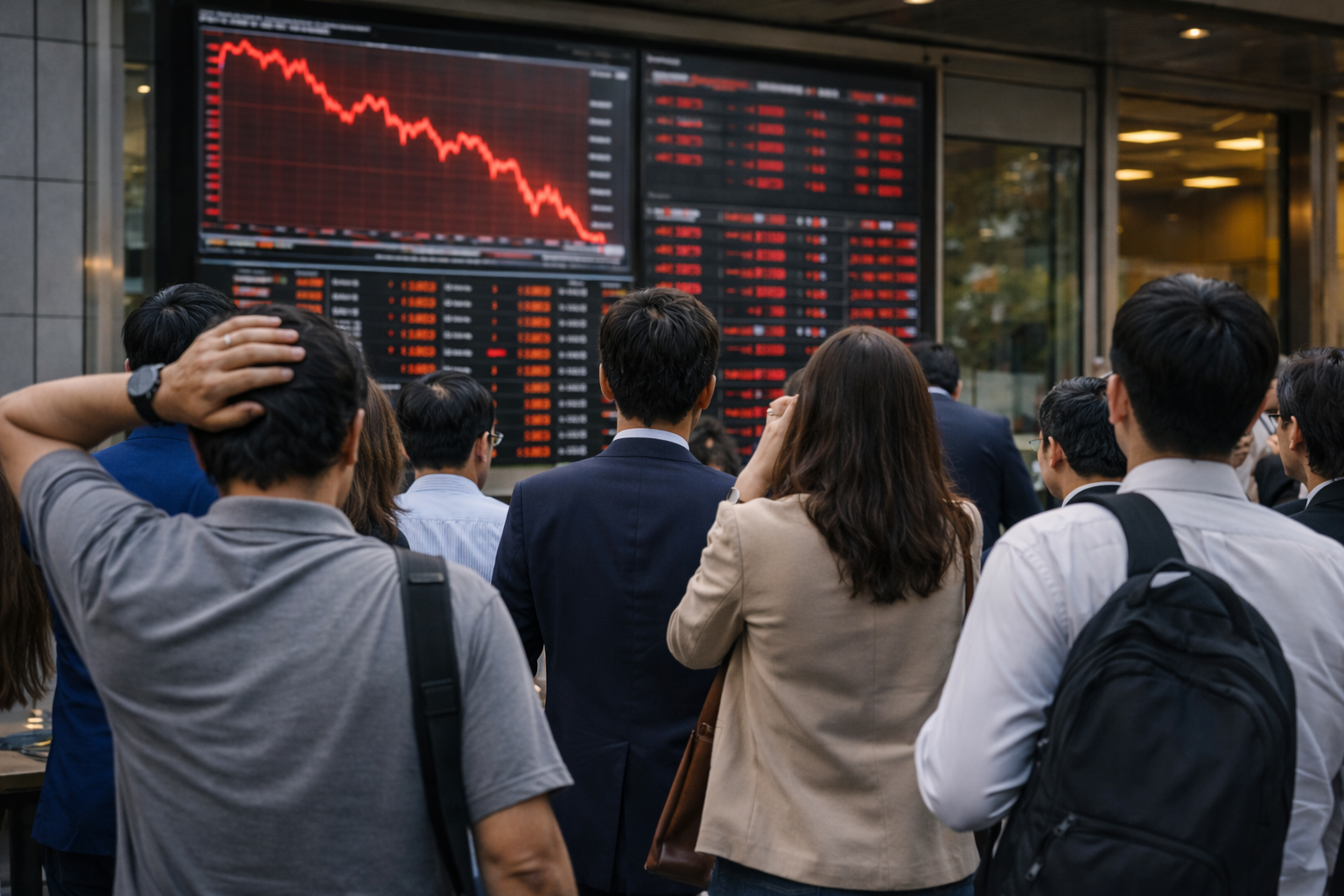
Foreign investors continued pulling money from Asian equities in July, but the headline outflow masks a striking shift underneath: capital moved away from the region’s biggest AI winners while selectively returning to markets with less dependence on the semiconductor boom.
Investors sold a net $25.48 billion of shares across seven major Asian markets during the month, extending the region’s foreign-selling streak to nine months.
Taiwan alone lost $22.95 billion and South Korea another $6.26 billion. Yet India attracted $2.12 billion and Thailand $1.46 billion, while Indonesia and the Philippines also recorded modest inflows.
The numbers suggest global investors are not simply abandoning Asia. They are becoming more selective about where they take risk.
Taiwan and Korea reveal the cost of crowded AI exposure
Taiwan and South Korea accounted for $29.21 billion of combined foreign selling in July, which is more than the region’s overall net outflow because buying elsewhere partly offset the withdrawals.
That concentration reflects how aggressively both markets had become tied to the AI infrastructure cycle.
South Korea’s rally was dominated by Samsung Electronics and SK Hynix, before the KOSPI suffered a violent reversal in July.
The index fell 22% during the month after more than doubling earlier in the year, as concerns around AI capital expenditure, leverage and memory-chip valuations triggered a sharp repositioning.
Taiwan faced a similar problem as semiconductor selling pulled the TAIEX sharply lower.
The index suffered its biggest single-day point decline on record in July, while foreign institutions accelerated withdrawals from a market heavily exposed to the global chip supply chain.
The fundamental concern was not that AI demand disappeared. Instead, investors started questioning the amount of capital required to sustain it.
Alphabet reported negative second-quarter free cash flow of $5.9 billion after spending $44.9 billion on capital expenditure, mostly on AI infrastructure.
Its cloud business remained exceptionally strong, with revenue jumping 82%, highlighting the tension between booming demand and the cost of supplying it.
Tesla told a similar cash-flow story. Operating cash flow reached $4.7 billion, but a surge in capital expenditure to $5.79 billion pushed free cash flow to negative $1.09 billion.
BNP Paribas strategists see those questions around chip demand, financing and debt servicing as important reasons investors reduced exposure to Korean and Taiwanese AI heavyweights.
Competition from cheaper Chinese AI models has added another uncertainty around how much infrastructure spending the industry ultimately requires.
India and Thailand become relative shelters, not outright winners
The other side of July’s flows looks very different.
India received $2.12 billion of foreign equity investment, while Thailand attracted $1.46 billion.
Indonesia and the Philippines recorded smaller inflows of $88 million and $69 million. Vietnam saw a marginal $12 million withdrawal.
HSBC strategist Herald van der Linde sees Asia’s extreme AI-sector volatility encouraging investors to spread their exposure more widely.
The bank recently raised India to neutral within its regional allocation, partly because the market offers a broader mix of financial, consumer and domestic-demand businesses rather than relying as heavily on semiconductors.
There are domestic reasons for renewed interest as well.
Jefferies points to Indian credit growth of roughly 17%-18%, led by corporate lending near 20%, alongside measures designed to attract foreign capital and stabilise the rupee.
But one month does not constitute a wholesale return. Foreign investors remained net sellers of Indian equities by $25.86 billion for 2026 through July despite the latest inflow.
July flows look more like rotation than a verdict on Asia
That makes July better understood as a change in relative preference than the end of Asia’s foreign-capital problem.
Taiwan and South Korea remain central to global AI supply chains, and the underlying demand picture has not collapsed.
Alphabet’s cloud growth, for example, shows that spending is generating substantial revenue even as infrastructure costs pressure cash flow.
South Korea also retains powerful long-term memory-chip fundamentals.
Goldman Sachs has argued that the recent Korean sell-off went too far, citing continued AI demand and tight memory supply even after the KOSPI’s correction.
The risk for investors is therefore less about AI disappearing and more about concentration.
When a small group of chipmakers carries an outsized share of a market’s gains, any reassessment of spending, margins or competition can produce unusually violent capital flows.
July’s numbers show that global money is responding by spreading its bets.
For now, that is helping India and parts of Southeast Asia, but it remains a diversification trade, not yet a broad vote of confidence in Asian equities.
The post Taiwan and Korea lose $29 billion in July: is money rotating away from AI? appeared first on Invezz
