
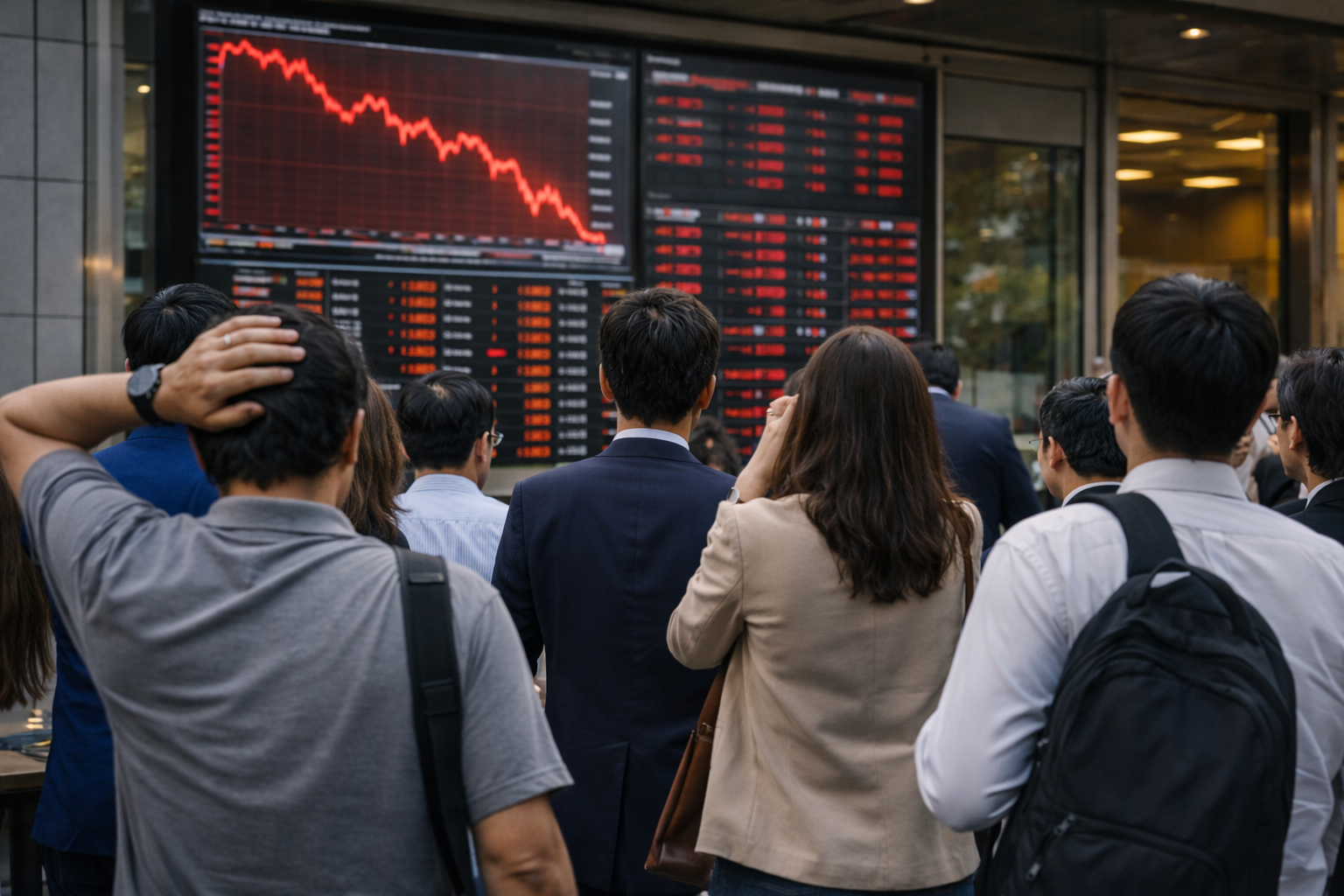
SK Hynix and Samsung Electronics shares fell sharply on Monday, giving back part of Friday’s record rebound as investors locked in profits after one of the most dramatic sessions in South Korean market history.
Samsung dropped 6.48% and SK Hynix lost 6.69% by 9:15 AM in Seoul, while the Kospi slid 4.25%.
The retreat followed Friday’s 26.81% surge in Samsung and SK Hynix’s 29.95% limit-up move, which helped the benchmark jump a record 17.91%.
Friday’s record rebound meets a reality check
Friday’s gains came after the Kospi had shed more than 17% across three sessions, leaving chip shares technically battered and short sellers exposed.
Strong results from Microsoft and Amazon also eased fears that major technology companies were preparing to reduce spending on artificial-intelligence infrastructure.
Foreign investors bought a net 7.22 trillion won of Korean shares, while institutions purchased 1.15 trillion won, according to the market data.
Those flows, combined with bargain-hunting and short-covering, pushed the market higher at extraordinary speed.
That scale made Monday’s profit-taking understandable.
Han Ji-young of Kiwoom Securities had warned that investors could take money off the table early this week after the Kospi’s unprecedented jump, the Korea JoongAng Daily reported.
Monday’s losses, therefore, do not necessarily signal a fresh deterioration in the chipmakers’ earnings outlook.
Yet the inability to hold even the first session after Friday’s rebound weakens the argument that the market has established a durable floor.
Leverage remains the market’s biggest fault line
The more important risk is positioning, not collapsing profits.
Peter Kim, senior managing director at KB Securities, told Reuters last week that the sell-off was “not driven by fundamental deterioration”.
He blamed fragile sentiment and forced unwinding in single-stock leveraged exchange-traded funds across Korea and overseas.
Kim also warned that the amount of leverage accumulated in the market meant the clean-out was unlikely to finish within one or two weeks.
That assessment matters because sharp rebounds can encourage traders to rebuild exposure before margin pressure has fully disappeared.
Gary Tan, a portfolio manager at Allspring Global Investments, said that “strong is no longer enough” in the current AI market.
Investors wanted clearer signals on long-term supply agreements, shareholder returns and the durability of the memory cycle, he said.
Also read- Top Nikkei 225 Index catalysts this week: yen rescue, Softbank earnings and more
China fears collide with strong memory demand
Longer-term concerns have not vanished. Investors are assessing Chinese memory-chip competition, advances in domestic semiconductor equipment and whether debt-funded AI capital expenditure can remain sustainable.
Chris Beauchamp, chief market analyst at IG, told The Guardian that Chinese chipmakers could eventually undercut established producers and compete aggressively on price.
The near-term picture is less bearish. Forrester analyst Alvin Nguyen described the memory-stock sell-off as an “overreaction” in comments to The Guardian, arguing that manufacturers still cannot produce enough chips to satisfy demand and that shortages could persist until 2030.
That tension makes the bull-trap label premature. Friday looks more like an unstable relief rally than proof of a lasting recovery.
Earnings and memory demand remain strong, but investors need evidence that forced deleveraging is ending, foreign buying is becoming consistent and hyperscalers remain committed to AI spending.
The post SK Hynix and Samsung stocks sink again: was Friday’s record rally a brutal bull trap? appeared first on Invezz
