
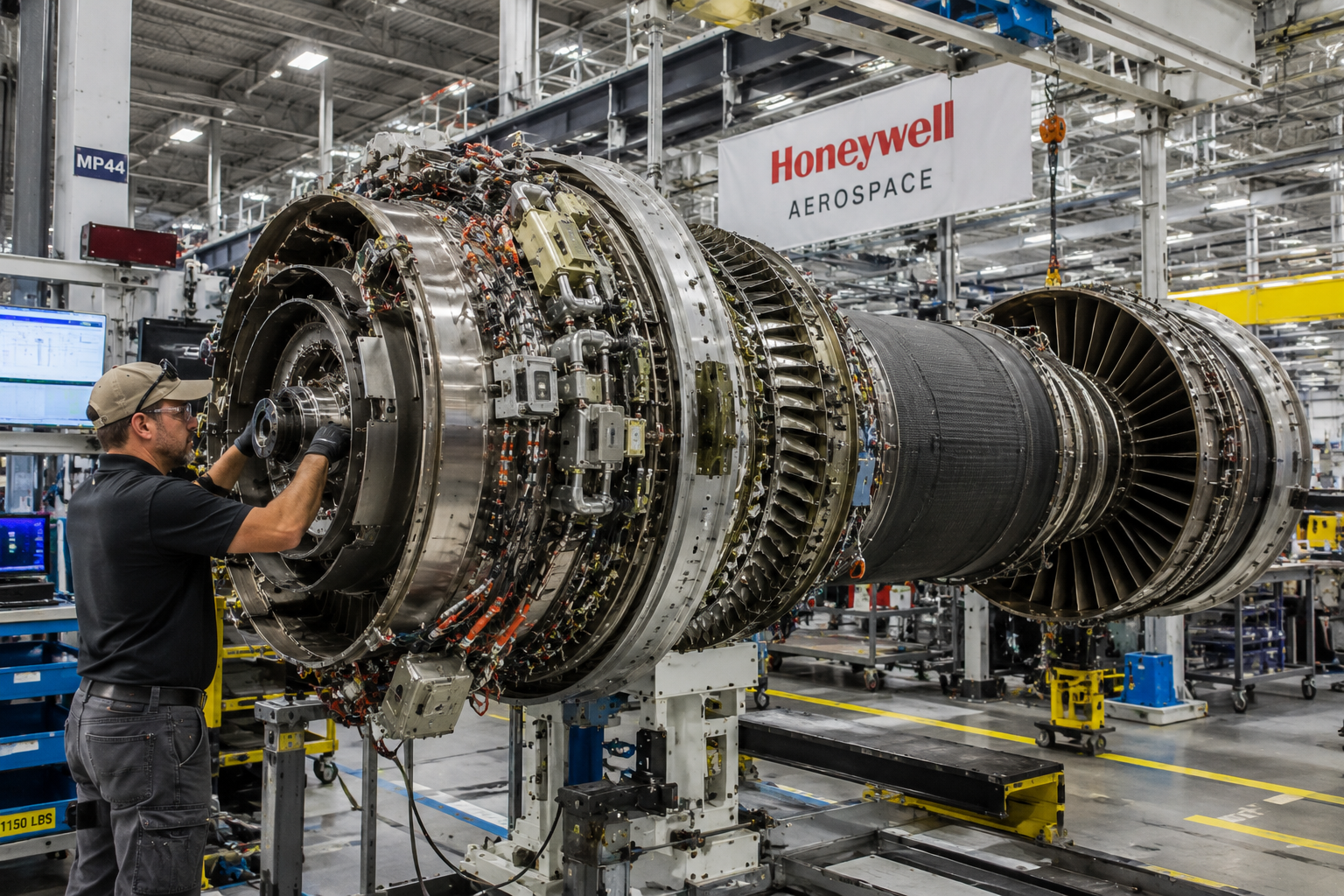
Honeywell Aerospace HONA shares plunged about 20% on Thursday after the newly independent aerospace and defense supplier reported weaker-than-expected second-quarter results and sharply reduced its full-year guidance, raising fresh concerns over execution and supply chain challenges.
The company, which completed its separation from Honeywell Technologies in June, reported second-quarter revenue of $4.52 billion, up 5% from a year earlier but below Wall Street’s expectation of $4.6 billion.
Operating profit came in at approximately $1 billion, missing analysts’ estimates of $1.1 billion and declining 7% year over year, partly due to inventory obsolescence charges.
Adjusted earnings were reported at $1.87 per share.
Despite modest revenue growth, investors reacted negatively to the company’s revised outlook, sending shares sharply lower.
Guidance cut weighs on investor confidence
Honeywell Aerospace lowered its outlook just weeks after issuing previous guidance, prompting concerns over the reliability of management forecasts.
The company now expects full-year organic revenue growth of 4% to 5%, down from its prior forecast of 7% to 9%.
It also reduced expected pro forma standalone adjusted EBITDA to between $4.35 billion and $4.45 billion from the earlier range of $4.65 billion to $4.75 billion.
Chief Executive Officer Jim Currier said, “For the second half of 2026, we believe it is prudent to align our guidance to our supply chain’s demonstrated capabilities at the end of the second quarter.”
Evercore ISI maintained its In-Line rating on the stock while lowering its price target to $210 following the earnings release.
Supply chain challenges remain in focus
Analysts pointed to continued operational issues as a major concern.
Melius Research analyst Scott Mikus wrote, “After a tough 1Q, during which Honeywell Aerospace’s core sales growth lagged Aerospace & Defense peers by a wide margin across all three end-markets (commercial aftermarket, commercial OE, and defense), 2Q wasn’t much better. The acute supply chain issue from last quarter did not improve as much as management had hoped.”
According to Mikus, Honeywell Aerospace generated 8% growth in commercial aftermarket sales, compared with approximately 23% growth reported by industry peers.
He added, “It’s no secret that Honeywell Aerospace has been a source of frustration for its customers, and the company’s $2 billion-plus of overdue backlog continues to grow.”
Mikus also warned, “Further, coming out of Covid, airlines have turned to repairs and PMA parts (akin to generic drugs in aerospace) to reduce maintenance costs and alleviate spare parts shortages. If [the company] can’t resolve its supply-chain issues and improve on-time delivery, it risks losing a portion of its future high-margin aftermarket revenue stream.”
Analysts remain cautious on recovery
Analysts said restoring investor confidence may take time as Honeywell Aerospace works to improve execution.
Vertical Research Partners analyst Rob Stallard wrote in a Barron’s report, “While it is good that Honeywell Aerospace recognizes that it has problems, fixing them will not be an overnight affair.”
He added, “While the company has a broadly diversified revenue mix, it has relatively less exposure to attractive Aerospace & Defense subsectors like large commercial engines or missiles than other companies. Put together, we see Honeywell’s growth continuing to lag its peers. While the valuation is relatively inexpensive, we fear that this could be a value trap.”
Honeywell Aerospace shares now trade at roughly 23 times expected 2026 earnings, well below the multiple commanded by GE Aerospace, which recently reported stronger profit growth and raised its own full-year guidance.
Analysts said Honeywell Aerospace is unlikely to close that valuation gap until it demonstrates sustained operational improvement and stronger execution.
The post Honeywell Aerospace stock sinks 20% after guidance cut clouds outlook appeared first on Invezz
